Exploring Medical Communication Labels: How They Enhance Tube Management and Patient Care
Understanding Labeling Systems for Catheters, Tubes, and Clinical Lines
In many clinical settings, patients often require multiple tubes, drains, and lines at the same time—such as central venous catheters, feeding tubes, urinary catheters, wound drains, and oxygen tubing. These tubes can look similar, especially in critical-care environments, and misidentification can lead to serious consequences.
To address this, Medical Communication Labels (also called Medical Labels, Healthcare Labels, Tube Labels, Catheter Labels, or Line Identification Labels) are widely used to ensure clarity, accuracy, and safety in patient care.
This article provides a comprehensive overview of what these labels are, how they are used, and why they are essential in modern clinical practice.

1. What Are Medical Communication Labels?
Medical Communication Labels are specialized identification stickers designed for tubes and lines placed on patients. They visually communicate critical information, helping healthcare professionals quickly recognize and manage different types of medical tubing.
These labels are designed to be:
Quick to read
Color-coded
Durable and water-resistant
Suitable for busy clinical environments
Easy to write on or print on
They are typically applied to lines such as:
IV tubing
Drains
Catheters
Enteral feeding tubes
Oxygen tubing
Central venous and arterial lines
2. Why Tube Labels Are Essential in Clinical Care
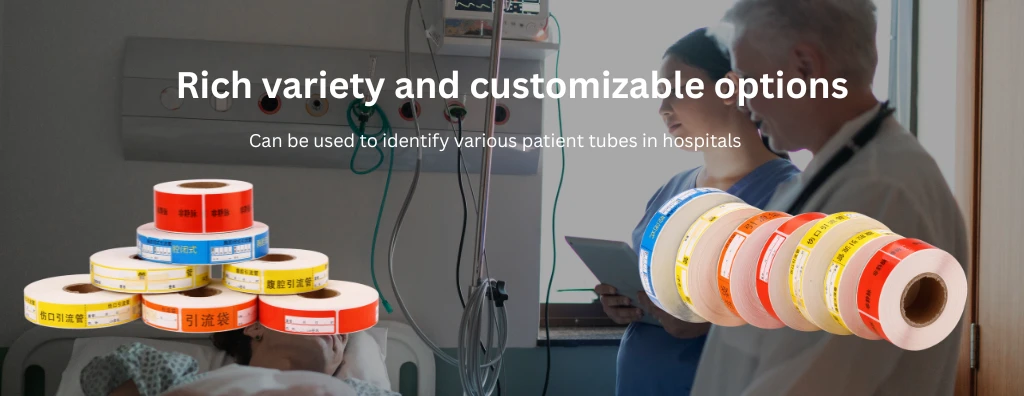
✔ 1. Clear Identification & Tube Differentiation
Patients in ICU or emergency units often have multiple tubes in place. Labels help staff distinguish between:
Infusion lines
Drainage tubes
Feeding tubes
Urinary catheters
Central venous catheters
Oxygen and suction lines
Color coding plus text reduces confusion and saves valuable time.
✔ 2. Accurate Information Recording
Tube Labels can include:
Insertion date
Replacement date
Tube length or depth (e.g., “20 cm”)
Clinician or nurse signature
Tube name
Flow direction (arrow icon)
These details help ensure proper daily assessment, tracking, and quality control.
✔ 3. Safety & Error Prevention
Clear labeling minimizes risks such as:
Accidental line removal
Incorrect tube manipulation
Wrong-line connections
Outdated tube usage
It enhances safety during emergencies or night shifts when visibility may be limited.
✔ 4. Standardized Clinical Management
Hospitals can achieve better standardization in nursing workflow by using unified label formats and color systems.
3. What Information Do Medical Communication Labels Include?
A complete Tube Label typically contains:
Tube name
e.g., “Central Venous Catheter”, “Nasogastric Tube”, “Urinary Catheter”Date
Insertion or replacement dateTube depth / length
e.g., 20 cmName or ID of operator
Nurse or clinician responsibleDirection indicator
arrow for flow directionColor code
Color represents tube type or clinical category
4. Where Are Medical Labels Used?
Medical Communication Labels are common in:
Intensive Care Units (ICU, CCU, NICU)
Emergency rooms
General wards
Operating rooms and recovery units
Long-term care facilities
Home care environments
Nursing facilities for elderly patients
They apply to:
IV lines
Drainage tubes
Feeding tubes
Suction tubing
Urinary catheters
Oxygen tubing
CVC / PICC lines
Wound drainage systems
Arterial and venous catheters
Epidural catheters
Enteral nutrition tubing
5. Specifications and Features of Tube Labels
Colors
Common options include:
Yellow
Bright Yellow
Fluorescent Yellow
Blue
Custom colors based on institutional standards
Typical Sizes
Common dimensions include:
13 × 40 mm
15 × 50 mm
17 × 50 mm
17 × 80 mm
Fully customizable sizes available
Materials
Coated paper (Coated sticker paper)
PP synthetic paper (tear-resistant)
Suitable for thermal or thermal-transfer printing
Characteristics
Water-resistant
Alcohol-resistant
Tear-resistant (synthetic paper)
Strong adhesive
Skin-friendly design
Roll format, approx. 500 labels per roll
Plastic core to reduce dust
6. Common Categories of Tube Labels
Medical facilities may use dozens of label types depending on clinical needs. Examples include:
Standard blank labels
IV line labels
Catheter labels
Drainage tube labels
Ostomy tube labels
Nasogastric tube labels
Feeding tube labels
Central venous catheter labels (CVC)
PICC line labels
Arterial line labels
Wound drainage labels
Negative pressure drainage tube labels
Chest tube labels
Foley catheter labels
Urinary drainage bag labels
Oxygen / suction tubing labels
Epidural catheter labels
Enteral nutrition tube labels
T-tube or biliary drainage labels
(…and many more depending on hospital protocols)
If needed, I can generate a downloadable “Complete Tube Label List PDF” for institutional use.
7. Recommended Usage Guidelines
To maintain accuracy and safety, clinical users typically follow these practices:
All tubes and lines must have labels
Labels are single-use and must be replaced if unclear
Color coding must be accurate
Labels must be checked during shift handover
Dates and lengths should be updated daily
Labels should be placed without covering critical scale markers
Adhesion should not interfere with tube fixation
8. Tube Label Management System (Institutional Recommendation)
Healthcare organizations often adopt standardized management methods such as:
1. Category-based color management
Each tube type corresponds to a fixed color.
2. Staff training
Consistent use across all clinical departments.
3. Regular audits
Ensure labels are readable and updated.
4. Label storage management
Prevent moisture, contamination, or adhesive deterioration.
5. Printer management
Ensure printers support required material and label formats.
9. Label Printer Selection Guide
When choosing printers for Medical Communication Labels, consider:
Printing method: thermal or thermal transfer
DPI resolution (≥203 dpi recommended)
Compatibility with tube label roll size
Ability to print variable data
Software/HIS system compatibility
Stable printing speed
Long-term durability and low maintenance
If you want a dedicated guide, I can create:
“How to Choose the Right Printer for Medical Communication Labels”
10. Conclusion
Medical Communication Labels play a crucial role in patient care. By providing:
Clear identification
Accurate information
Standardized workflow
Reduced operation risk
They support safer, more efficient clinical environments.
Whether used in critical care, general wards, long-term care, or home medical scenarios, tube labeling systems ensure that every tube is properly documented and easily understood by all caregivers involved.
Share this article
Follow us
A quick overview of the topics covered in this article.
- 1. What Are Medical Communication Labels?
- 2. Why Tube Labels Are Essential in Clinical Care
- 3. What Information Do Medical Communication Labels Include?
- 4. Where Are Medical Labels Used?
- 5. Specifications and Features of Tube Labels
- 6. Common Categories of Tube Labels
- 7. Recommended Usage Guidelines
- 8. Tube Label Management System (Institutional Recommendation)
- 9. Label Printer Selection Guide
- 10. Conclusion