Disposable Tourniquet Supplier Guide: How to Choose a Reliable Manufacturer for Bulk Orders
A practical buyer’s guide covering product specifications, latex-free requirements, OEM/ODM customization, and six criteria for evaluating disposable tourniquet suppliers.
Healthcare procurement teams, medical distributors, and private-label brands all face the same challenge: finding a disposable tourniquet supplier that delivers consistent quality, competitive pricing, and reliable delivery at scale. The stakes are high — a subpar tourniquet can cause vein access failure, patient discomfort, and cross-contamination risks that no facility can afford.
This buyer’s guide walks through everything you need to evaluate when sourcing disposable tourniquets in bulk: product specifications, material requirements, OEM/ODM customization, and the six criteria that separate reliable manufacturers from risky ones.
What Makes a Quality Disposable Tourniquet?
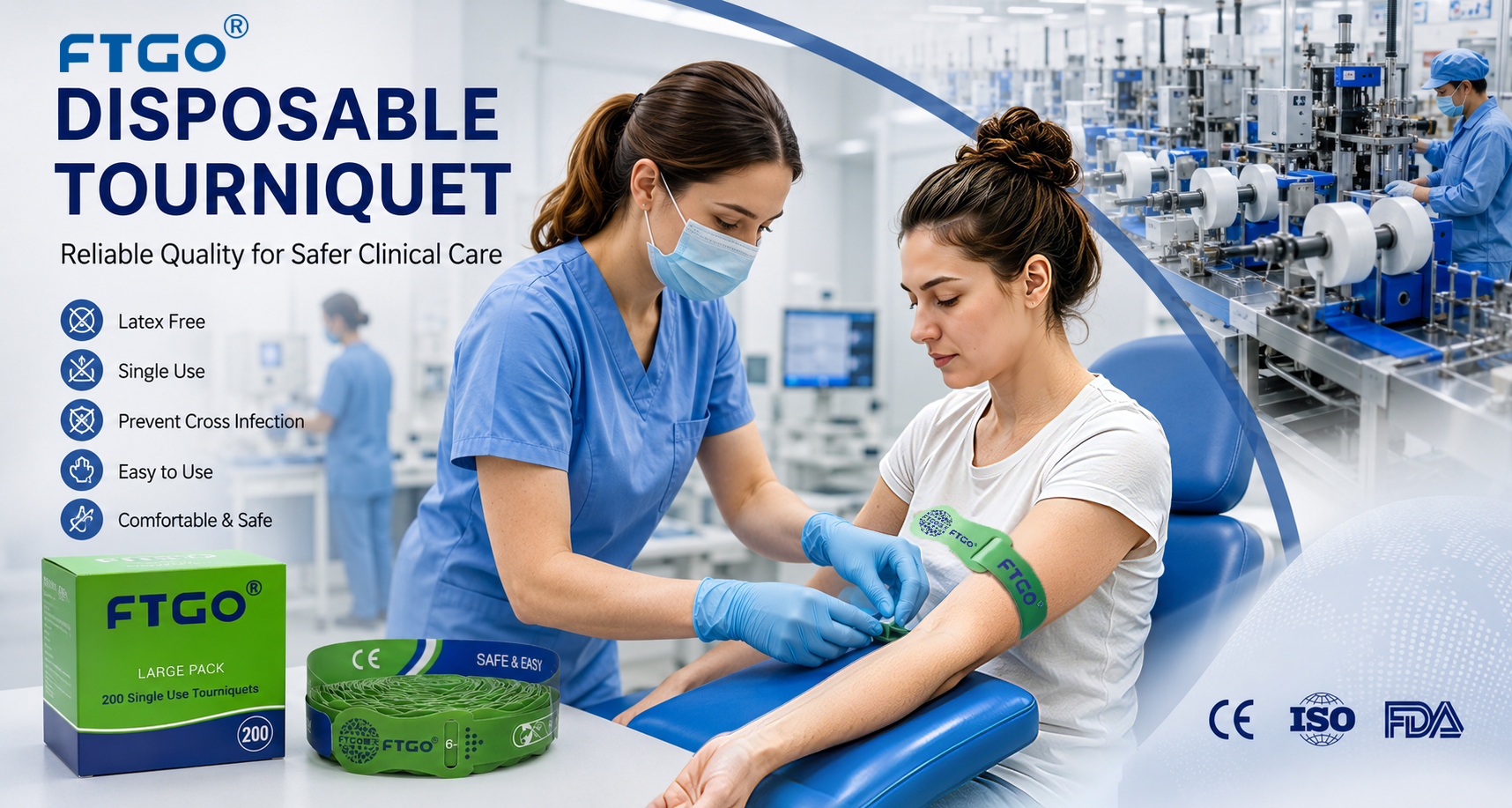
A disposable tourniquet is a single-use medical consumable designed for venipuncture, blood collection, and IV preparation. Its primary function is to temporarily restrict venous blood flow, causing veins to engorge for easier needle access. After use on a single patient, it is discarded — eliminating the cross-contamination risk associated with reusable tourniquets.
Quality disposable tourniquets share several characteristics: they are made from latex-free materials, provide a secure fit with adjustable positioning, and offer convenient, intuitive operation for clinicians working at speed. The material should be soft enough for patient comfort yet firm enough to maintain consistent venous occlusion throughout the procedure.
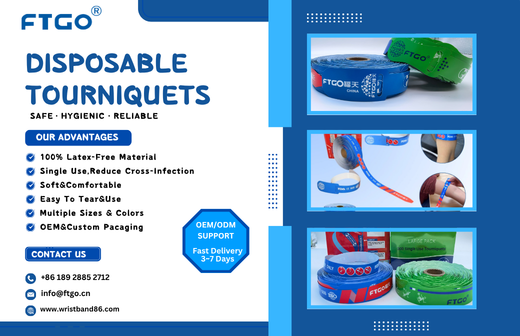
FTGO manufactures disposable tourniquets in two standard configurations — a 558mm x 30mm blue-green model and a 492mm x 20mm red-blue model — both available with custom sizing options. These specifications cover the majority of adult venipuncture scenarios, with custom sizes available for pediatric, bariatric, or specialized clinical applications.
Why Single-Use Design Matters: Infection Control
The shift from reusable to disposable tourniquets is driven by one overriding factor: infection control. Multiple studies have documented that reusable tourniquets carry dangerous pathogens — including MRSA, VRE, and C. difficile — even after standard disinfection protocols. The textured surfaces, buckle crevices, and fabric layers of reusable tourniquets create micro-environments where bacteria thrive and resist cleaning.
A 2019 study found contamination rates exceeding 70% on reusable tourniquets in active clinical use. For hospitals, clinics, and blood collection centers, this represents an unacceptable risk of cross-contamination between patients.
Single-use disposable tourniquets eliminate this vector entirely. One patient, one tourniquet, zero transfer risk. For procurement managers, the calculation is straightforward: the marginal cost difference per unit is negligible compared to the potential cost of a single hospital-acquired infection, which can exceed $40,000 per case.
Key takeaway: Regulatory bodies and infection control guidelines increasingly favor single-use medical devices in high-contact procedures. Stocking disposable tourniquets is not just a best practice — it is becoming a compliance requirement in many jurisdictions.
OEM/ODM Customization: What Distributors Need to Know
For medical supply distributors, wholesalers, and private-label brands, OEM/ODM customization is often the deciding factor in supplier selection. The ability to customize size, color, logo, and packaging allows distributors to differentiate their offerings in a commoditized market.
When evaluating OEM/ODM capability, ask potential suppliers these questions:
- Can they produce custom sizes beyond the standard 558mm x 30mm and 492mm x 20mm configurations?
- Do they offer full-color customization, or are options limited to a preset palette?
- Can they apply custom logos and branding — and what is the minimum order quantity for branded products?
- What packaging formats are available? Individual sterile packs, roll dispensers, custom retail packaging?
- What is the typical lead time from design approval to bulk delivery?
As a disposable tourniquet manufacturer in China, FTGO provides full OEM/ODM services including custom sizing, color matching, logo printing, and packaging design. This allows distributors to build private-label product lines without investing in their own manufacturing infrastructure — reducing both upfront capital and ongoing operational complexity.
Six Criteria for Choosing a Disposable Tourniquet Supplier
Not all manufacturers are created equal. Use these six criteria to evaluate potential suppliers before committing to a bulk order:
- Manufacturing capability — Can the supplier maintain consistent quality at scale? Ask about production capacity, quality control processes, and batch testing documentation. Factory-direct manufacturers like FTGO offer stable bulk production with rigorous QC protocols.
- Certifications — At minimum, the supplier should hold ISO 13485 (medical device quality management) and CE marking for EU compliance. FDA registration is essential for US distribution. Request current certificates, not verbal claims.
- MOQ flexibility — What is the minimum order quantity? For new distributors testing a market, a high MOQ creates cash flow pressure. Look for suppliers with tiered MOQs that scale with your business growth.
- Lead times — How long from order to delivery? Reliable suppliers provide clear production timelines and maintain buffer stock for repeat orders. Ask for references from existing distribution partners.
- OEM/ODM experience — Has the supplier successfully executed custom branding projects? Request samples of previous OEM work — logo printing quality, color matching accuracy, and packaging finish all reveal manufacturing maturity.
- Export and logistics — Does the supplier have experience shipping to your target markets? Familiarity with customs documentation, medical device import regulations, and international freight logistics prevents costly delays at the border.
Cost Considerations for Bulk Orders
When calculating the total cost of sourcing disposable tourniquets, look beyond the unit price:
- Unit price — Factory-direct pricing from manufacturers like FTGO eliminates middleman markups. Bulk orders of 10,000+ units typically unlock significant per-unit discounts.
- Shipping and freight — Sea freight is cost-effective for large volumes but adds 3-6 weeks to lead time. Air freight is faster but significantly more expensive per unit.
- Customs and duties — Medical consumables may qualify for reduced tariff rates in certain markets. Confirm HS codes and import regulations with your freight forwarder.
- Payment terms — Negotiate terms that protect cash flow. Common arrangements include 30% deposit with 70% balance before shipment, or letter of credit for larger orders.
Frequently Asked Questions
What sizes are available for disposable tourniquets?
Standard sizes include 558mm x 30mm (blue-green model) and 492mm x 20mm (red-blue model). Custom sizes are available for specialized applications including pediatric and bariatric use.
Are disposable tourniquets latex-free?
Quality disposable tourniquets are manufactured from latex-free materials. Always verify latex-free certification with your supplier before purchasing.
What is the MOQ for OEM/ODM custom-branded tourniquets?
MOQ varies by supplier and customization level. FTGO offers flexible MOQs that scale with your distribution volume — contact us for specific quoting based on your requirements.
Conclusion
Choosing the right disposable tourniquet supplier comes down to three things: product quality, customization capability, and supply reliability. A supplier that offers latex-free materials in multiple standard sizes, full OEM/ODM customization, and proven export experience gives your distribution business a competitive edge while protecting your end customers.
Ready to Source Disposable Tourniquets in Bulk?
FTGO provides factory-direct latex-free disposable tourniquets with OEM/ODM customization, ISO9000 and CE certification, and global shipping for distributors and wholesalers.
Share this article
 How to Choose the Right Hospital Wristbands for Patient Identification
Follow us
A quick overview of the topics covered in this article.