How Patient Identification Barcode Wristbands Improve Hospital Safety and Efficiency
In modern healthcare, accurate patient identification is not just a best practice — it is a critical safety requirement. According to the World Health Organization (WHO), patient misidentification remains one of the leading causes of preventable medical errors worldwide. From medication administration to surgical procedures, a single misidentification can lead to severe consequences. This is where patient identification barcode wristbands come into play, serving as the foundation of a reliable, scalable, and error-reducing identification system.
At FTGO, we specialize in manufacturing high-quality medical wristbands designed to meet the rigorous demands of healthcare facilities. In this article, we will explore how barcode patient identification wristbands work, why they matter, and what healthcare providers should look for when choosing the right solution.
What Is a Patient Identification Barcode Wristband?
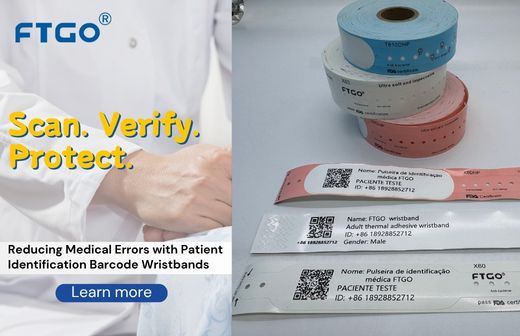
A patient identification barcode wristband is a medical-grade wristband worn by patients during their hospital stay. It features a printed barcode — either a 1D (linear) or 2D (QR code) — that encodes essential patient information such as name, medical record number, date of birth, ward, and admission date. When scanned by a barcode reader or a personal digital assistant (PDA), the wristband instantly links the patient to the hospital’s Health Information System (HIS), enabling real-time verification of identity at every point of care.
These wristbands are typically made of skin-friendly, latex-free materials such as ultra-soft nano-silicone and latex-free PET. They remain comfortable for prolonged wear, ideal for newborns, children and elderly patients with sensitive skin.
Why Barcode Patient Identification Matters
01 Reducing Medication Errors with Barcode Scanning
One of the most significant benefits of using barcode patient identification wristbands is their integration with Barcode Medication Administration (BCMA) systems. BCMA is a safety protocol that requires nurses to sca
n both the patient’s wristband and the medication barcode before administering any drug. This dual-scan verification ensures the “Five Rights” of medication administration: the right patient, the right drug, the right dose, the right route, and the right time.
02 Preventing Misidentification in High-Risk Scenarios
In busy hospital environments — especi
ally emergency rooms, intensive care units, and surgical wards — staff are often under immense pressure. Patients may be unconscious, unresponsive, or share similar names. Barcode patient wristbands for hospital safety provide an unambiguous, machine-readable identifier that
eliminates reliance on verbal confirmation or handwritten labels.
For example, before drawing blood for a transfusion, the phlebotomist scans the patient’s wristband to confirm identity and match it against the blood sample label. This process, mandated by patient safety standards, drastically reduces the risk of transfusion-related errors.
03 Enhancing Workflow Efficiency Across Departments
Beyond safety, barcode wristbands st
reamline clinical workflows. When a patient is transferred between departments — from the emergency room to radiology, for example — the wristband barcode ensures continuity of identification. Staff can scan the wristband to pull up lab orders, medication schedules, and clinical notes without manually searching the HIS database. This reduces administrative overhead and allows clinicians to focus more time on direct patient care。
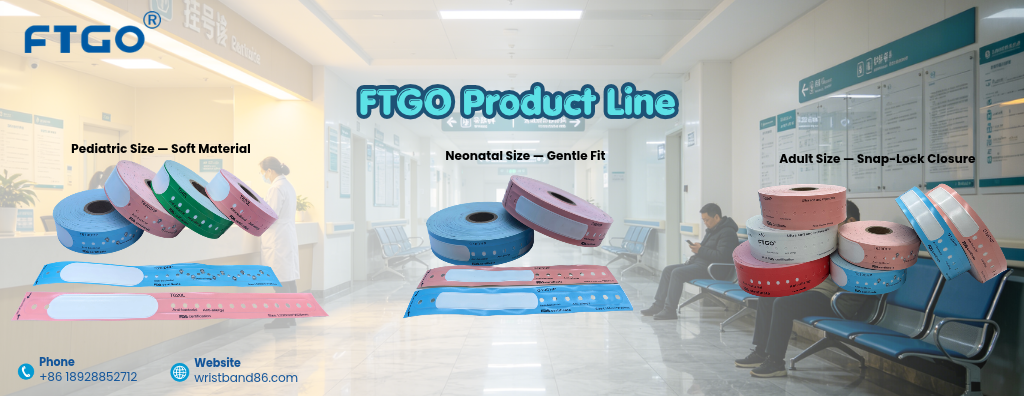
Key Features of High-Quality Barcode Patient ID Wristbands
Not all wristbands are created equal. Healthcare facilities should evaluate the following features when selecting medical barcode patient identification wristbands:
✓ Print Quality and Barcode Readability
The wristband surface must support high-resolution thermal printing to produce crisp, scannable barcodes. Faded or smudged barcodes lead to scan failures, which can disrupt workflows and compromise safety. FTGO wristbands are engineered with premium thermal coating technology, ensuring that printed barcodes remain sharp and readable even after days of wear.
✓ Durability in Clinical Environments
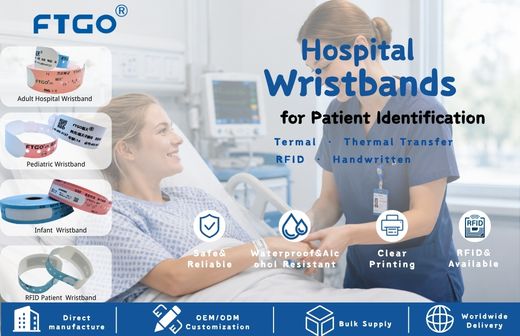
Hospital wristbands are exposed to water, alcohol, soap, hand sanitizers, and friction throughout a patient’s stay. A durable patient identification wristband must resist smudging, fading, and tearing under these conditions. Look for wristbands with waterproof and alcohol-resistant coatings, such as those offered by FTGO, which maintain print integrity for the entire duration of a hospital stay.
✓ Skin Safety and Comfort
Patients wear identification wristbands 24/7 during their hospitalization. The material must be hypoallergenic, latex-free, and free from phthalates to prevent allergic reactions or skin irritation. This is particularly important for pediatric and newborn patient barcode wristbands, where the skin is especially delicate. FTGO offers wristbands in multiple sizes — including specialized neonatal sizes — to ensure a safe and comfortable fit for every patient demographic.
✓ Tamper-Evident and Non-Transferable Design
To maintain the integrity of patient identification, wristbands should feature a tamper-evident closure — either a snap-lock or a self-adhesive band with a security cut line. This design prevents the wristband from being transferred between patients, which could lead to catastrophic misidentification. Once secured, the wristband cannot be removed without visible damage, alerting staff to potential tampering.
Compliance with International Patient Safety Standards
The use of patient identification barcode wristbands is not merely a recommended practice — it is mandated by major healthcare accreditation bodies worldwide. The Joint Commission International (JCI) requires that all patients be identified using at least two identifiers, and barcode wristbands serve as a standardized tool to fulfill this requirement. Similarly, GS1 healthcare standards recommend the use of machine-readable barcodes on patient wristbands to ensure global interoperability and data accuracy.
FTGO wristbands are designed to support compliance with these frameworks. Our products are compatible with GS1-standard barcode formats, including Data Matrix and Code 128, ensuring that healthcare facilities can meet accreditation requirements without additional system modifications.
Steps to Implement Barcode Wristband Systems in Your Hospital
Implementing a barcode-based patient identification system requires careful planning. Here are the key steps healthcare administrators should follow:
1.Assess Your Current Identification Workflow
Before introducing barcode wristbands, evaluate your facility’s existing patient identification process. Identify pain points such as manual data entry errors, illegible handwriting, or delayed information retrieval. This assessment will help you determine the scope of implementation and set measurable goals — for example, reducing medication errors by 30% within six months.
2.Choose Compatible Printing Hardware
Select thermal printers that integrate with your HIS and support the barcode formats your clinical staff will use. FTGO wristbands are compatible with widely used thermal printer models, including those from Zebra, Honeywell, and TSC, making integration straightforward and cost-effective.
3.Train Clinical Staff on Barcode Scanning Protocols
Technology alone cannot improve patient safety — staff training is essential. Conduct hands-on training sessions for nurses, physicians, and technicians on proper scanning techniques, BCMA workflows, and exception handling (e.g., what to do when a barcode will not scan). Reinforce the message that scanning the patient identification barcode wristband is a non-negotiable step before any clinical intervention.
4.Monitor and Optimize
After deployment, track key metrics such as scan success rates, medication error rates, and patient identification incidents. Use this data to identify areas for improvement, whether it involves upgrading printer settings, adjusting wristband placement protocols, or providing additional training for specific departments.
Choosing the Right Wristband for Your Facility
Thermal Printing Wristbands vs. Direct-Print Solutions
Hospitals typically choose between two printing methods: thermal printing wristbands and direct-print solutions. Thermal printing is the preferred choice for most facilities because it does not require ink ribbons, produces high-quality barcodes quickly, and integrates seamlessly with standard thermal printers already used in hospital admissions departments. FTGO thermal wristbands are compatible with major printer brands and support both 1D and 2D barcode formats.
Color Coding for Visual Identification
Many hospitals use color-coded wristbands to communicate patient alerts at a glance — for example, red for allergies, yellow for fall risk, and purple for “Do Not Resuscitate” (DNR) status. When combined with barcode patient identification, color coding adds an extra layer of visual safety, allowing staff to identify critical alerts even before scanning the barcode. FTGO offers wristbands in multiple colors while maintaining the same print quality and durability standards across the range.
How FTGO Supports Healthcare Providers Worldwide
As a specialized manufacturer of medical wristbands, FTGO is committed to supporting healthcare facilities with products that meet international quality standards. Our patient identification barcode wristbands are:
- CE-certified and manufactured under strict quality control processes
- Latex-free and phthalate-free, complying with global medical material safety standards
- Waterproof and alcohol-resistant, ensuring barcode readability throughout the patient’s stay
- Available in adult, pediatric, and neonatal sizes, with snap-lock and adhesive closure options
- Compatible with standard thermal printers used in hospital information systems
We understand that every healthcare facility has unique requirements. Whether you operate a small community clinic or a large multi-campus hospital network, FTGO provides customizable wristband solutions tailored to your identification protocols, printing infrastructure, and patient demographics.
The Future of Patient Identification
As healthcare continues to digitize, the role of the barcode wristband is evolving. Integration with electronic health records (EHR), real-time location systems (RTLS), and even RFID-enabled wristbands is becoming more common. However, the barcode wristband remains the backbone of patient identification — it is simple, cost-effective, universally compatible, and proven to reduce errors.
Healthcare facilities that invest in high-quality barcode wristbands today are building a foundation that can seamlessly integrate with future technologies, ensuring that their identification systems remain robust and scalable for years to come.
Conclusion
Patient identification barcode wristbands are far more than a simple accessory — they are a critical component of hospital safety infrastructure. By enabling accurate, real-time identity verification, they reduce medication errors, prevent misidentification, streamline clinical workflows, and ultimately save lives.
Choosing the right wristband supplier is equally important. With FTGO’s range of medical barcode patient identification wristbands, healthcare providers can trust that they are equipping their staff with durable, comfortable, and scannable identification tools that meet the highest industry standards.
Share this article
 Disposable Tourniquet: The Complete Guide for Healthcare Facilities and Medical Distributors
Follow us
A quick overview of the topics covered in this article.